How I Built a Viral Design Tool in 2009 and Accidentally Prototyped Today's AI Debate
June 29, 2025
There's a moment in every designer's career when they realize the rules they've been following might not be rules at all. Mine came during the 2008 recession, when I was trying to break into the design field and asked myself a seemingly contradictory question:
"As a designer, how do we do away with designers?"
Sixteen years later, with AI tools like Midjourney and ChatGPT and Adobe's Express suite of AI-powered tools sparking widespread anxiety about creative jobs being automated away, that question feels prophetic. The fundamental challenge remains the same: designers need to be creative and strategic thinkers first and foremost—professionals who can apply systematic thinking to any tool, process, or production method that comes along.
The Perfect Storm
February 2009. The economy had cratered. Design hiring had virtually stopped. I was an outsider looking in, armed with nothing but hustle and a dangerous willingness to provoke the very community I wanted to join.
But there was more brewing beneath the surface. The design establishment—led by organizations like AIGA—was still hyperfocused on print design and classic design standards, even as the world was rapidly shifting digital. I'll never forget being at a party of creative friends when someone pulled out the first iPhone (launched just two years earlier). It instantly became the talk of the entire gathering.
Looking at that interface, I knew immediately this was going to change everything about how we interact with technology and each other.
Here was this revolutionary device that threw traditional design hierarchies out the window, yet the design institutions were still debating kerning and grid systems as if pixels didn't exist.
The tension was palpable: a field clinging to its established expertise while the tools and mediums that would define the next decade were already in everyone's pockets.
Instead of creating another portfolio piece to get lost in the noise, I decided to create the noise itself. The concept was deliberately provocative: a website that let anyone generate Swiss-style design posters by simply typing text and clicking "Swissify." Helvetica on black backgrounds. Grid-based layouts. The visual language that had taken decades to master, reduced to a single button press.
I called it AnyoneCanSwiss, designed and coded the entire platform in 48 hours, and launched it into the world during the worst economic crisis designers had faced in decades.
Going Viral Before "Going Viral" Was a Thing
What happened next surprised everyone, including me:
- 40,000 visitors in 48 hours
- Over 12,000 user-generated posters from people around the world
- Eventually growing to over 11,000 preserved examples that I uploaded to Flickr as a permanent archive
- Featured on Swiss-Miss, Aisleone, and major design blogs across the internet
The design community didn't just notice—they had feelings about it.
The responses revealed everything: "******* brilliant! someone finally agrees with me!" sat alongside "I find this site kind of insulting but at the same time very funny."
Established designers felt compelled to defend their profession in lengthy comment threads, with one noting that "Claiming that the Swiss style is easy to reproduce, because you only need to use Helvetica and a grid, is simply not understanding graphic design."
The most telling response came from a commenter who observed that the project actually disproved its own premise: browsing through the user-generated gallery, most posters "completely miss the mark" of quality Swiss design, inadvertently proving that good design requires more than just the right tools.
The Larger Movement
AnyoneCanSwiss wasn't operating in a vacuum. The design community was ripe for this kind of provocation, as evidenced by similar projects that emerged around the same time. A year later, someone created "Angry Paul Rand," a satirical Twitter account where the legendary designer supposedly rants from "designer heaven".
These projects shared a common thread: using humor and automation to question design's sacred cows—whether Swiss minimalism or the cult of personality around design legends.
The fact that multiple creators were independently poking at design establishment revealed a deeper cultural moment where the field was ready to examine its own assumptions.
The Ironic Validation
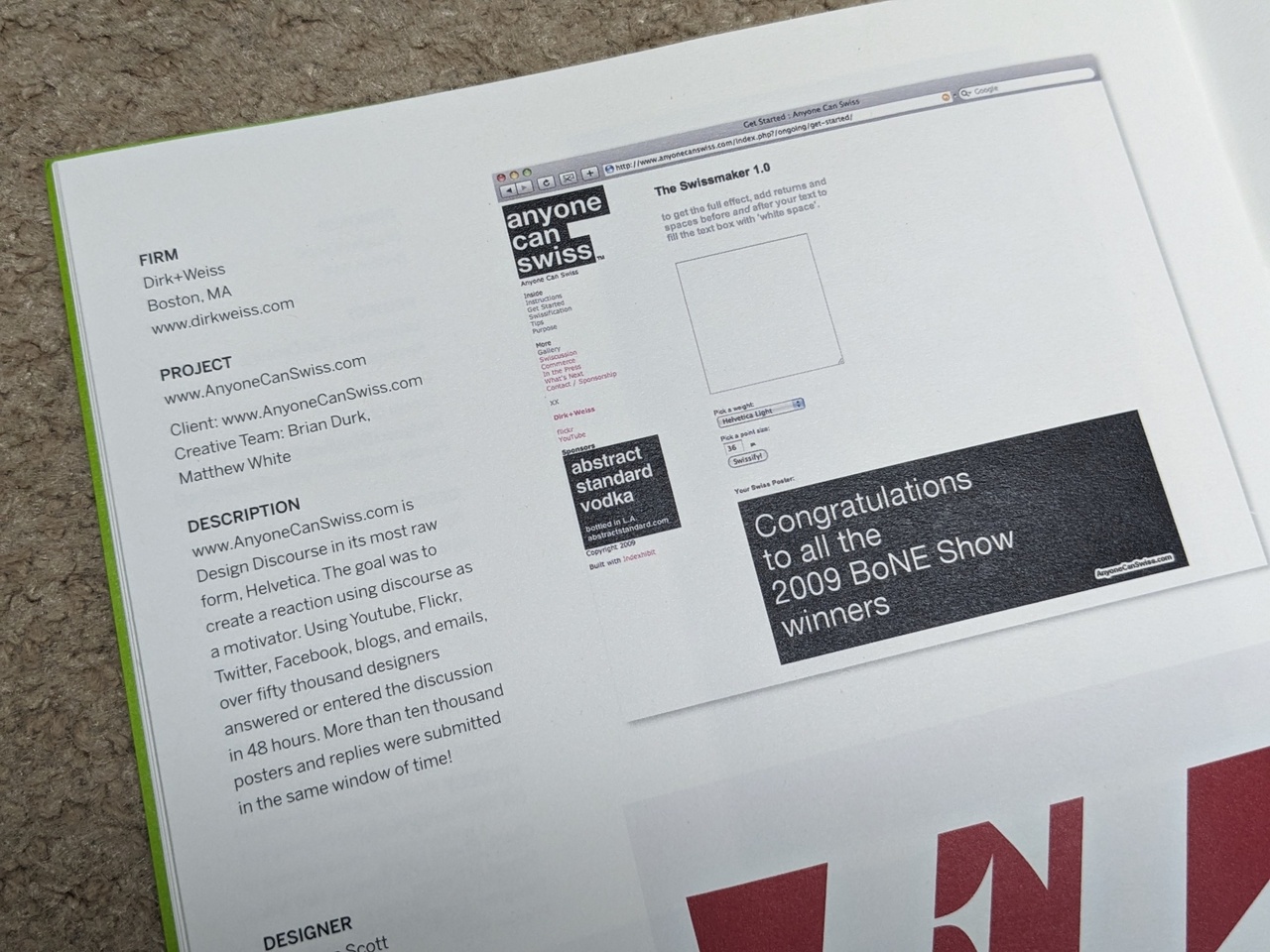
The ultimate vindication came months later when AnyoneCanSwiss won the AIGA Best of New England Design Award—judged by creative directors from Apple, HP, and boutique design agencies. We had literally won a design award for questioning the necessity of designers.
The judges understood what the project really was: not an attack on design, but a catalyst for discourse about design's evolving role in an increasingly automated world.
The Through Line
Looking back now, AnyoneCanSwiss wasn't just a moment of recession-era provocation. It was the first iteration of a philosophy I've been refining ever since: using rapid prototyping to force important conversations about the future of creative work.
The 48-hour build time wasn't just about speed—it was about maintaining creative momentum and cognitive flow. When you can move from concept to working prototype without losing the thread of your thinking, entirely different kinds of ideas become possible.
This principle has guided my work ever since, culminating in my current AI-augmented design practice where complex prototypes go from brain dump to user testing in hours, not weeks.
The tools have evolved, but the core insight remains: when you remove technical friction from the creative process, you free human intelligence to focus on the problems that actually matter.
The Prediction Realized
AnyoneCanSwiss asked whether automation would make designers obsolete. Sixteen years later, we have our answer: automation doesn't replace designers—it amplifies the designers who learn to work with it.
The Swiss design automation that felt threatening in 2009 was actually preparing us for today's AI-augmented design tools. Both democratize technical execution, and both force the same fundamental question: if anyone can execute, what unique value do professional designers bring?
The answer, I've learned, isn't about protecting creative gatekeeping. It's about embracing our role as creative directors of increasingly powerful tools—using technology to explore more ideas, test more concepts, and solve more complex problems than ever before.
What Hasn't Changed
The most important lesson from AnyoneCanSwiss wasn't about technology or tools. It was about the power of asking uncomfortable questions at exactly the right moment.
In 2009, I was an outsider using rapid prototyping to break into the design field by questioning its foundations. Today, I'm using the same approach to advance the field by demonstrating what's possible when human creativity partners with artificial intelligence.
The conversations have evolved, but the method remains constant: build something quickly, make it provocative enough to generate genuine discourse, and let the community's response reveal the deeper truths about where the industry is heading.
Some things never change. The best way to predict the future is still to prototype it, ship it, and see what people have to say.
This retrospective grew out of rediscovering old coverage of AnyoneCanSwiss while researching viral design projects from the 2009 recession. You can see my current AI-augmented design experiments at tchr01.github.io/ux.
Sources:
- Swiss-Miss. "Anyone Can Swiss." February 5, 2009. https://www.swiss-miss.com/2009/02/anyone-can-swiss.html
- Aisleone. "Anyone Can Swiss." February 4, 2009. http://www.aisleone.net/2009/02/04/anyone-can-swiss/
- AnyoneCanSwiss Flickr Archive. Over 11,000 user-generated posters preserved from the 2009 project. https://www.flickr.com/photos/anyonecanswiss/
- "Angry Paul Rand." ANewDesigns Blog, August 2010. https://anewdesigns.blogspot.com/2010/08/angry-paul-rand.html